
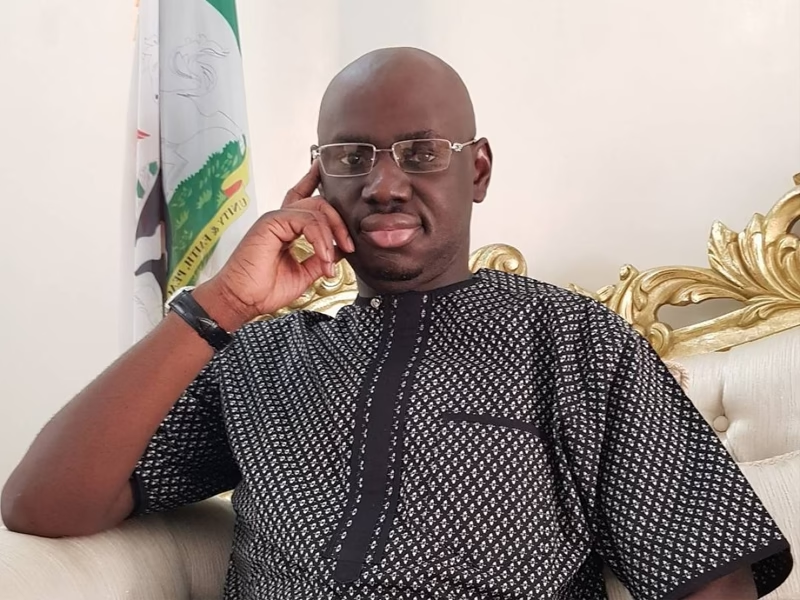
Political activist Timi Frank has raised serious concerns about the future of Nigeria’s democracy, warning that the nation could descend into unrest similar to Nepal’s political crisis if the 2027 general elections are not credible. His warning comes at a time when debates over electoral reforms, governance, and public trust in Nigeria’s democratic institutions are intensifying.
Frank, a former Deputy National Publicity Secretary of the All Progressives Congress (APC), made the statement in Abuja, stressing that the Independent National Electoral Commission (INEC) must urgently pursue reforms to restore faith in the electoral process. According to him, without free, fair, and transparent elections, Nigeria risks political instability that could spiral into mass protests comparable to the 2020 EndSARS demonstrations.
“The lessons of history are clear. Where people lose confidence in the ballot, they often take to the streets. Nigeria is at a critical crossroads, and INEC must act decisively to avoid a repeat of the chaos we witnessed during the EndSARS protests or worse,” Frank cautioned.
He drew parallels with Nepal, which has struggled in recent years with violent protests, political deadlock, and public disillusionment in its democratic institutions. Frank warned that if Nigeria continues to ignore electoral reforms, it could face similar unrest, fueled by widespread poverty, youth unemployment, and disenchantment with governance.
In his statement, Frank called on the international community, particularly the United States, to exert pressure on Nigerian authorities to prioritize meaningful electoral reforms. Interestingly, he singled out U.S. President Donald Trump, urging him and other global leaders to support Nigeria’s quest for credible elections.
“Let the U.S. impose stiffer sanctions on judges, justices, and INEC officials that may compromise the electoral process because we believe and support Donald Trump’s position on enthroning true democracy across Africa,” Frank said.
He further emphasized that credible elections cannot take place unless security agencies act professionally and impartially. According to him, security operatives have too often been complicit in rigging elections in favor of the ruling party, undermining public confidence.
“Security agencies must be unbiased and stop their usual role in rigging elections for the ruling party. They must protect voters and prevent political violence. Failure to do so risks pushing Nigeria into a situation worse than Nepal’s recent unrest, given our challenges with poverty and tyranny,” he warned.
Frank also raised concerns about leadership at INEC, arguing that the country needs a new electoral commission chairman with proven integrity as the tenure of Professor Mahmood Yakubu nears its end. He stressed that leadership at the commission will play a decisive role in whether the 2027 elections are credible or controversial.
“The credibility of elections depends heavily on those who manage the process. Nigerians deserve an INEC chairman who commands trust and demonstrates impartiality. Without this, the legitimacy of the 2027 polls will be in jeopardy,” he added.
Analysts note that Frank’s warnings reflect a growing anxiety among Nigerians about the credibility of elections. Despite Nigeria’s return to civilian rule in 1999, elections have frequently been marred by irregularities, voter suppression, violence, and allegations of judicial compromise. While electoral reforms have been discussed repeatedly, many believe progress has been too slow to meet the rising expectations of citizens.
Frank’s call for international pressure underscores how deeply trust in local institutions has eroded. By invoking sanctions against compromised officials, he seeks to create external accountability mechanisms where internal ones have failed. However, critics argue that relying on foreign powers to resolve Nigeria’s democratic challenges raises sovereignty concerns and may not produce lasting results.
Still, the activist insists that Nigeria cannot afford another flawed election cycle. With the memory of EndSARS protests still fresh, he argued that young people, who make up the majority of the electorate, will not hesitate to mobilize if they believe their votes have been stolen again. Combined with worsening poverty, inflation, and unemployment, Frank suggested the conditions are ripe for widespread unrest if the political class fails to act.
For him, the solution lies in immediate reforms, professional security conduct, and leadership accountability. Only then, he said, can Nigeria chart a path toward stability, prosperity, and genuine democracy.
As the countdown to 2027 begins, Frank’s warning serves as both a cautionary tale and a rallying cry. Whether Nigeria avoids the scenario he fears will depend on the political will of its leaders and the resilience of its democratic institutions.
More News on Gistrad
