
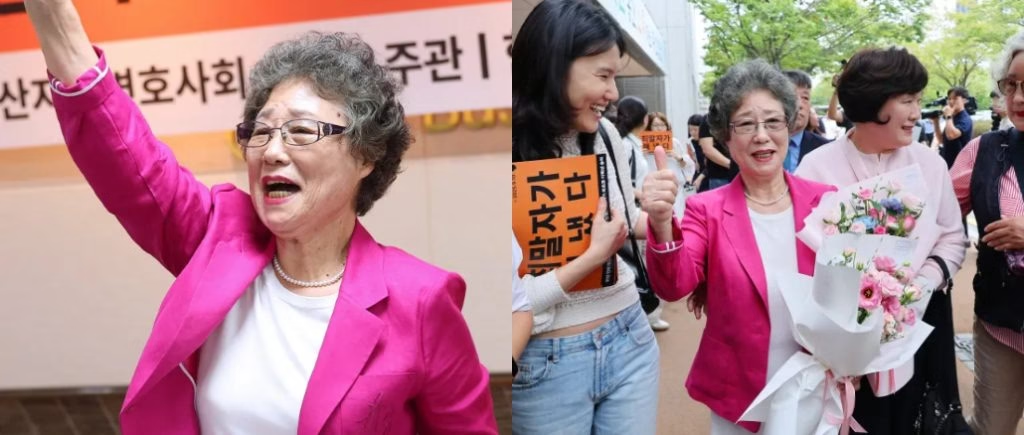
A South Korean court has officially acquitted 79-year-old Choi Mal-ja, overturning a conviction that had haunted her for more than six decades. The case dates back to 1964, when Choi, then only 18 years old, bit off part of her rapist’s tongue while attempting to escape a sexual assault. For that act of resistance, she was convicted of grievous bodily harm and spent 10 months behind bars, while her attacker walked away with a suspended sentence.
This week, after 61 long years, justice finally caught up with her ordeal. The Busan District Court ruled in a retrial that her actions were lawful self-defence and proportionate to the danger she faced. The ruling immediately sparked celebration among women’s rights activists, legal experts, and everyday citizens who hailed it as a victory not only for Choi but for survivors of sexual violence everywhere.
Choi, who had lived much of her life under the weight of what she described as a “false stain,” expressed her relief and joy outside the courthouse. Raising her hands in triumph, she declared: “I, Choi Mal-ja, am finally innocent!” Her voice, both shaky with age and steady with conviction, resonated as a symbol of long-delayed justice.
The original case took place in an era when South Korea’s legal and cultural attitudes toward women and sexual violence were heavily biased against victims. At just 18, Choi was assaulted by a man identified only as Roh, who forced his tongue into her mouth during the attack. In an act of desperation, she bit down, severely injuring him and creating the opportunity to escape. Instead of being recognized as a victim of assault, she was branded a criminal. Her attacker was convicted only of intimidation and avoided prison altogether.
The retrial came decades later, inspired in part by the momentum of the global #MeToo movement, which shed new light on systemic injustices against women. Advocates in South Korea argued that Choi’s case epitomized how survivors had historically been silenced and punished for fighting back. The new ruling acknowledged those injustices directly, with the presiding judge declaring that her response was reasonable given the violent nature of the assault.
Prosecutors, who had initially been responsible for her wrongful conviction, issued a rare public apology. They admitted the immeasurable pain and suffering Choi endured, not only from the assault but from being wrongly punished for defending herself. For many, this apology was as significant as the acquittal itself, reflecting a broader shift in South Korea’s judicial system toward acknowledging and correcting historical wrongs.
Women’s rights activists celebrated the ruling as a breakthrough moment. They emphasized that Choi’s acquittal sends a powerful message: victims of sexual assault have the right to defend themselves without fear of being treated as criminals. Legal analysts added that the decision could influence future cases, strengthening protections for women and clarifying the boundaries of lawful self-defence in situations of sexual violence.
For Choi, the decision marks the end of a long and painful chapter. She had carried the burden of a criminal record for most of her adult life, living with shame and stigma despite having been the victim in the original incident. Her vindication now not only clears her name but also restores her dignity in the eyes of society.
The story has also sparked wider conversations about justice delayed and the importance of retrials in addressing miscarriages of justice. Many have questioned why it took six decades for the courts to recognize what seemed obvious: that Choi was acting in self-defence. Others have called for systemic reforms to ensure that survivors of sexual assault are never again subjected to such prolonged injustice.
As South Korea reflects on the significance of this ruling, Choi’s story has become more than a personal triumph. It stands as a reminder of the resilience of survivors, the power of persistence, and the possibility of change even after decades of silence. For women around the world, especially those who continue to fight against systems that criminalize their survival, her acquittal represents a landmark moment of justice finally served.
