
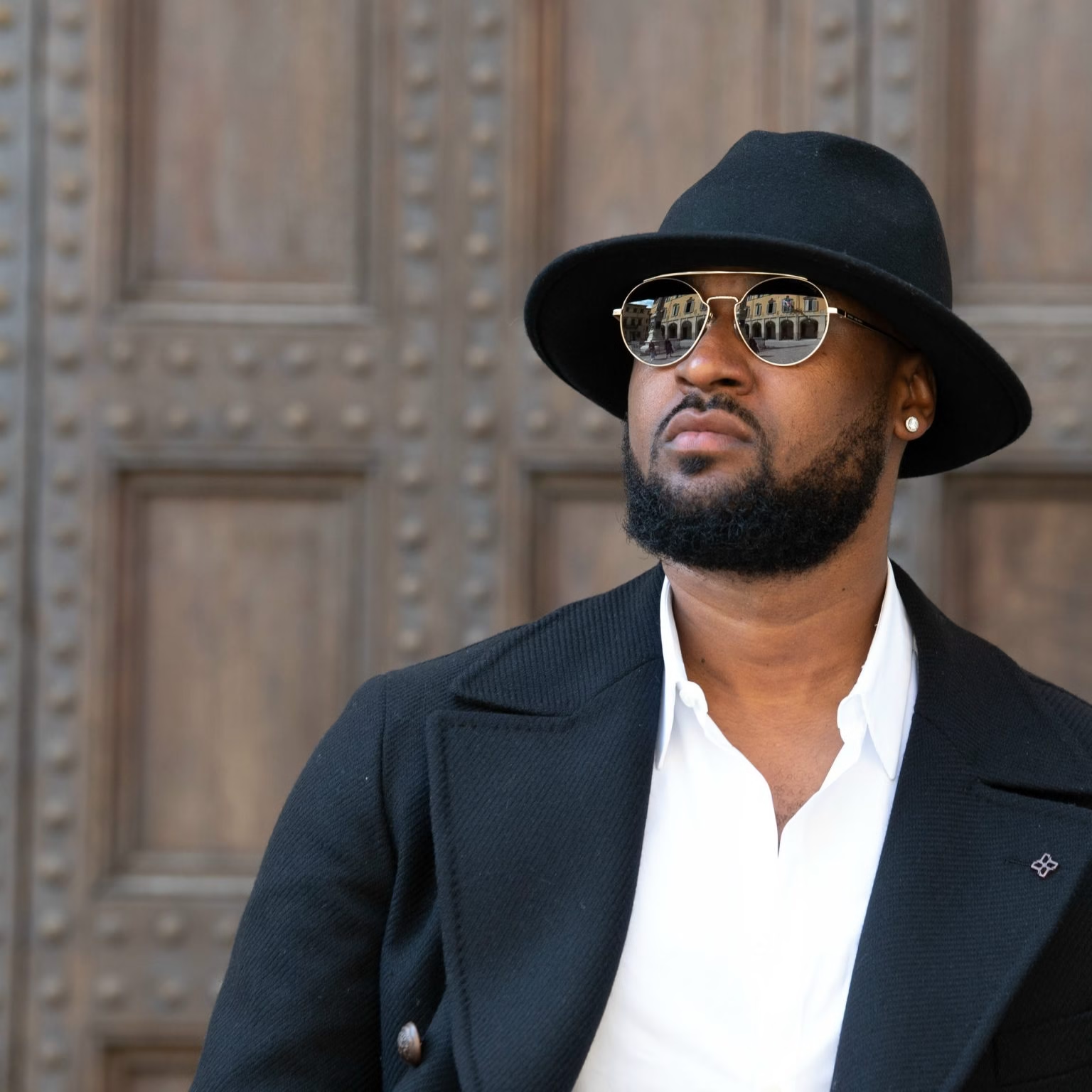
Italian-Nigerian artist, composer, and entrepreneur, Charles Onyekachi Onyeabor, has called for a more genuine discussion regarding racism and malevolence in African cultures, urging fellow Africans to refrain from shifting the blame solely onto white individuals.
Onyekachi, the eldest offspring of renowned Afro-funk musician William Onyeabor, expressed in a post on his social media profile that, while history cannot overlook the heinous acts perpetrated by white colonialists and slave traders, it is equally true that malevolence does not belong exclusively to any one race.
“Malevolence is not a white phenomenon; it is a human condition,” he stated. “It is egocentric and deceptive to assert that only white people are evil. The truth is that the human race is flawed and biased.”
He contested the prevalent notion that white individuals are inherently more malevolent, arguing that Africans have merely chosen to disregard the calculated ways in which other races function, particularly in safeguarding their own.
“They value and shield their communities. They exhibit solidarity. They consider future generations and the lasting consequences of their decisions,” he observed.
“On the other hand, far too many Africans focus solely on the present, neglecting the future or how today’s actions will influence the next generations.”
Onyekachi proceeded to provide instances of everyday wickedness within African neighborhoods:
“You purchase a plot of land, and another African appears claiming ownership. Was it a white man who did that? Your neighbor contaminates your food out of envy. Was that the doing of the white man? Our leaders remain in power for years while their people endure hunger and hardship. Is that the responsibility of the white man?”
He also touched on the involvement of Africans in the transatlantic slave trade.
“Let’s not overlook the fact that it was black individuals who initially sold their fellow blacks into slavery. The whites did not simply walk into Africa and start taking people.”
Regarding racism, Onyeabor highlighted the nuanced ways Africans display racial prejudice even amongst themselves.
“Just a few days ago, a friend greeted me and asked: ‘How are you? How’s your white wife and white son?’” “If a white person said, ‘How’s your Black wife and Black child?’ we’d instantly deem it as racism. So why do we not recognize it as racist when we do it ourselves?”
He also condemned the treatment of mixed-race individuals both on the continent and abroad.
“A mixed-race child is often not wholly accepted in either realm. In the white realm, they are categorized as black and face the same discrimination. In the black realm, they’re labeled ‘white’ and treated as outsiders. Ultimately, the child is meant to belong everywhere but is made to feel that they belong nowhere.”
He added that African women sometimes overlook black men who marry white women, failing to acknowledge their matrimony fully:
“They regard him as if he is still single. Why? Because of the biases nestled in our own hearts.”
Addressing tribalism within African communities, Onyeabor, whose headline event called “The Charles Onyeabor Show” is scheduled for October 24 in Florence, Italy, remarked, “We cry out against racism, yet here in Africa, a Yoruba individual declares, ‘God forbid I marry an Igbo or Hausa.’ Parents oppose their children for loving someone from a different tribe. Hatred flows among us daily.”
He characterized this as “hypocrisy at its highest,” advocating for self-examination.
“This world is not split into wicked and racist whites and innocent blacks. It is divided into wicked and racist people and good people. Malevolence and racism are ubiquitous, even in Africa. Until we acknowledge our own shortcomings and cease being hypocritical, we will continue to point fingers while neglecting the evils within our own communities.
